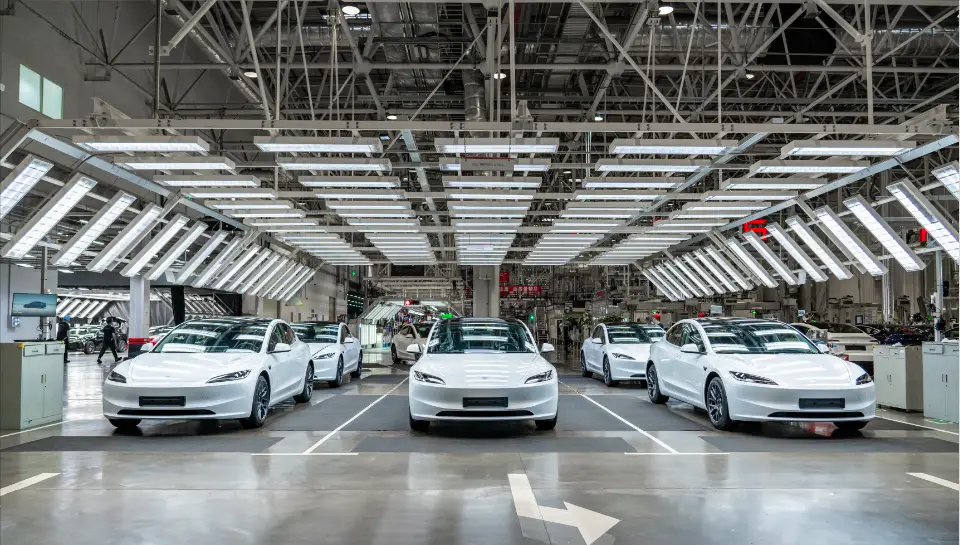

On July 24, 2025, Tesla CEO Elon Musk publicly acknowledged the company’s imbalanced strategic focus during an earnings call, announcing that the mass production plan for the humanoid robot Optimus would be delayed from 2025 to early 2026, and pledged to increase technical investment in the automotive business. This statement was interpreted by the market as a strategic return to core operations, driving Tesla’s stock price up by 2.3% the next day, with its market value rebounding to approximately $1.2 trillion. The following is an analysis of the underlying logic and subsequent impacts of the incident:
I. Background of the Apology: Strategic Imbalance, Financial Pressure, and Shifting Business Focus
Musk had previously over-committed to the Optimus project, claiming that its valuation could reach $20-30 trillion, and shifted resources toward robot research and development. However, the project has progressed slowly due to issues such as cost control of human-like dexterous hands and delays in design iterations, leading investors to question its feasibility. The Q2 2025 earnings report showed that Tesla’s automotive business revenue fell 12% year-on-year, net profit decreased by 20.7% (the largest single-quarter decline in nearly a decade), revenue from carbon credits dropped 51% year-on-year, and tariff costs increased by $300 million.
Musk has been deeply involved in U.S. politics and supported the policies of the Trump administration. However, policies such as the termination of electric vehicle tax credits and the imposition of supply chain tariffs under the “Big and Beautiful Act” directly impacted Tesla. In Q2 2025, U.S. market sales fell 20% year-on-year, and new tariff costs reached $300 million. Additionally, Musk’s public disagreements with Trump further heightened market concerns about policy risks.
On August 1, a Florida court ruled that Tesla was one-third liable for a 2019 autonomous driving fatal accident and required it to pay $243 million in compensation. This ruling set a record for damages in the autonomous driving field, triggering public doubts about the safety of the Autopilot system and potentially affecting the promotion of the Full Self-Driving (FSD) feature.
II. Market Reaction: Stock Rebound and Confidence Restoration
In the earnings call, Musk promised to prioritize solving the “software-defined vehicle” technical bottlenecks in the automotive business, including optimizing battery management systems and improving the efficiency of autonomous driving algorithms. Tesla plans to launch FSD V12 by the end of 2025, which will achieve more accurate road recognition and decision-making. This statement is regarded as a key shift in the technical route.
To cope with U.S. tariff policies, Tesla is accelerating the construction of a Gigafactory in Monterrey, Mexico, which is expected to start production in 2026 with an initial annual capacity of 500,000 units, mainly supplying the North American market. Meanwhile, it is cooperating with CATL to introduce a lithium iron phosphate battery production line in Germany to reduce costs.
Despite the short-term rebound in stock prices, there are still divergent expectations for Tesla in the market. UBS lowered its target price from $341 to $280, noting that its valuation depends on the dual verification of the profit recovery of the automotive business and technological breakthroughs in Optimus. However, institutions such as BlackRock have increased their holdings of Tesla stocks, betting on the commercial potential of FSD.
III. Subsequent Challenges: Triple Pressures from Technology, Law, and Market
The mass production of Optimus has been delayed until 2026. In addition to technical bottlenecks, China’s rare earth export controls have hindered the production of high-performance motors and sensors, further exacerbating supply chain risks. Tesla is negotiating with Beijing on rare earth magnet export licenses and accelerating the independent research and development of alternative materials.
The autonomous driving accident compensation ruling may trigger more similar lawsuits. As of August 2025, there are over 200 pending lawsuits involving Autopilot worldwide. Unfavorable rulings will directly affect brand reputation and insurance costs.
In Q2 2025, while the overall European electric vehicle market grew by more than 20%, Tesla’s sales plummeted by more than one-third year-on-year: registrations in Germany fell 59%, in France 59%, and in the UK 36%. Its European market share dropped sharply from 1.8% to 1%, mainly impacted by the electrification transformation of traditional automakers and competition from local brands.
IV. Industry Insights: The Art of Strategic Balance for Tech Giants
Musk’s apology indicates that tech giants need to maintain a dynamic balance between cutting-edge exploration and core businesses. If Tesla can achieve the recovery of its automotive business through FSD technological breakthroughs and supply chain optimization, while steadily advancing the Optimus project, it is still expected to maintain its leading position in new energy vehicles.
Musk’s political involvement has led Tesla to suffer policy backlashes, which sounds an alarm for other tech companies. In the future, enterprises need to establish more flexible political risk hedging mechanisms, such as diversified market layouts or strengthening policy lobbying capabilities.
The implementation of the EU’s “General Artificial Intelligence Code of Conduct” and the U.S. “AI Bill of Rights” requires Tesla to strengthen safety verification and data transparency in autonomous driving technology research and development. For example, using digital twin technology to realize accident scene retrospection to cope with increasingly strict regulatory reviews.
Musk’s strategic adjustment is a key turning point for Tesla to deal with multiple crises. In the short term, the stock rebound reflects the market’s expectation for the recovery of the automotive business; in the medium and long term, it is necessary to observe the progress of FSD technological breakthroughs, Optimus mass production, and the recovery of the European market. This incident not only affects Tesla’s own destiny but also reflects the survival challenges of global tech giants in terms of technological innovation, policy games, and ethical compliance. For investors, it is necessary to pay close attention to the delivery volume in Q4 2025, the implementation effect of FSD V12, and the technical iteration of Optimus, which will become the core indicators for judging Tesla’s value.


