In June 2025, NVIDIA CEO Jensen Huang announced plans to build 20 new “AI factories” in Europe. This strategic layout aims to promote the upgrading of Europe’s AI industry through the reconstruction of computing power infrastructure. The following is an in-depth analysis based on the latest developments:
I. Strategic Goals: Building Sovereign AI Infrastructure
Technology-Driven Industrial Transformation
NVIDIA’s AI factories will be centered on the latest Blackwell architecture (such as the GB200 NVL72 system), with a single cluster computing power of 800 petaFLOPS, which is 3 times higher than the previous generation H100 and 30% lower in power consumption. These factories will cover full scenarios from large model training to industrial digital twins, for example:
German Industrial AI Cloud: Equipped with 10,000 Blackwell GPUs, it supports enterprises such as Siemens and BMW to shorten their design cycles by 40% and reduce production line failure rates by 50%.
French Mistral Compute Platform: Driven by 18,000 Grace Blackwell systems, it can support model training for 300 startups simultaneously, focusing on the development of French large models to meet the EU’s data sovereignty requirements.
Driven by Both Policies and Market
The EU’s “AI Continent Action Plan” explicitly invests 20 billion euros to build 5 AI super factories, requiring that at least 30% of computing power be used for local scientific research. NVIDIA’s layout directly responds to this strategy, for example:
UK Nebius Data Center: Deploying 14,000 Blackwell GPUs to provide federated learning support for NHS medical image processing while meeting the data localization requirements of the Data Act.
Norwegian Telenor Hydropower Data Center: With a PUE (Power Usage Effectiveness) as low as 1.1, it reduces energy consumption by 40% compared to traditional data centers, complying with EU green computing power standards.
II. Specific Implementation Plans: From Computing Power Supply to Industrial Empowerment
In-depth Integration in Vertical Fields
Automotive Industry: NVIDIA cooperates with Mercedes-Benz, whose in-vehicle AI system supports L3+ level autonomous driving; Volvo’s next-generation models will adopt Thor chips with 2000 TOPS of computing power to achieve full-scenario coverage of urban roads.
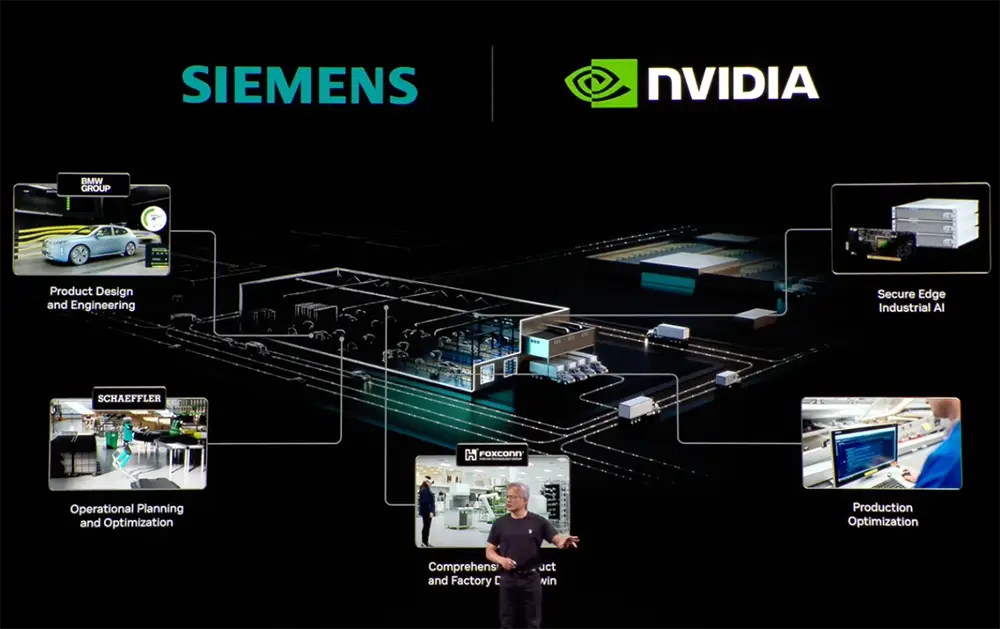
Industrial Manufacturing: Jointly building a “Digital Twin Cloud” with Siemens, connecting 150,000 industrial devices to help BMW reduce welding defect rates from 0.3% to 0.05%; Airbus uses the computing power platform to optimize the design of A350 wings, shortening wind tunnel test time from 8 weeks to 3 days.
Ecosystem Construction
Developer Support: NVIDIA’s “Startup Acceleration Program” provides European enterprises with 250 million US dollars in computing power subsidies annually, attracting 7,000 startups to join the ecosystem.
Technology Center Network: Establishing AI technology centers in Germany, Sweden, Italy, etc., cooperating with the Bayern KI Alliance to promote research on digital medicine and open-source robots, and accelerating skill training and quantum computing research and development.
III. Challenges and Risks: A Triple Game of Technology, Policies, and Competition
Supply Chain and Production Capacity Bottlenecks
NVIDIA can only produce 500,000 H100/H200 chips per month, while the total demand for under-construction factories in Europe reaches 1.2 million, extending the delivery cycle to 9-12 months.
U.S. export controls may affect the supply of advanced chips; a factory in Germany was forced to reduce its computing power scale by 40% due to the inability to obtain A100 chips.
Policy Compliance Pressure
The EU’s General Artificial Intelligence Code of Conduct requires AI models to pass ethical reviews, and core algorithms must be stored locally. NVIDIA needs to embed traceable systems in factory design, such as realizing transparent production processes through digital twin technology.
Data localization requirements increase compliance costs; for example, the French Mistral Compute platform needs to isolate French language corpora and restrict cross-regional data flow.
Competitor Dynamics
AMD acquired Finland’s Silo AI, gaining a 300-person team and open-source model technology, and plans to launch customized AI solutions in Europe.
Intel cooperates with the Italian government to build a supercomputer based on MI400X GPUs, targeting 1,000 ExaFLOPS of computing power, directly competing with NVIDIA.
IV. Industry Impact: Reshaping the Global AI Competition Pattern
Europe’s AI Autonomy Process
NVIDIA’s factories will help Europe form a 3,000 ExaFLOPS computing power cluster by 2027, a 10-fold increase from 2025, narrowing the gap with China and the United States.
The EU plans to leverage 200 billion euros in private investment through the “InvestAI” fund, promoting AI factories to become engines of regional economic growth.
Competition for Discourse Power in Technical Standards
NVIDIA’s CUDA-Q platform has been integrated with Denmark’s Gefion supercomputer to realize hybrid programming of AI and quantum computing, potentially dominating future quantum AI technical standards.
The Blackwell architecture adopted by European AI factories improves computing power utilization to 82% through 3D hybrid bonding technology, significantly leading the industry average of 55%, and may become a benchmark design for next-generation data centers.
V. Future Outlook: Balancing Innovation and Compliance
The first batch of factories (such as the German Industrial AI Cloud and French Mistral Compute) will be put into operation to verify the commercial feasibility of industry solutions.
The EU may introduce stricter AI ethical review rules, and NVIDIA needs to integrate real-time monitoring systems in factory deployment to cope with supervision.
If all 20 factories are completed, Europe’s AI computing power will account for 20% of the global total, forming a tripartite balance with China and the United States.
NVIDIA needs to respond to the rise of local European technologies; for example, Mistral AI’s French large models may replace general models in specific fields, affecting the structure of computing power demand.
Huang Renxun’s European AI factory plan is not only a commercial layout but also a microcosm of the global competition for technological hegemony. Through the dual strategy of “hardware + ecosystem”, NVIDIA attempts to build a technological moat in Europe while addressing policy and competitive challenges. The success of this strategy will depend on supply chain resilience, compliance innovation capabilities, and collaborative efficiency with local partners. For investors, attention should be paid to factory completion progress, the actual performance of the Blackwell architecture, and dynamic adjustments in EU regulatory policies, which will be core indicators for judging the value of NVIDIA’s European strategy.