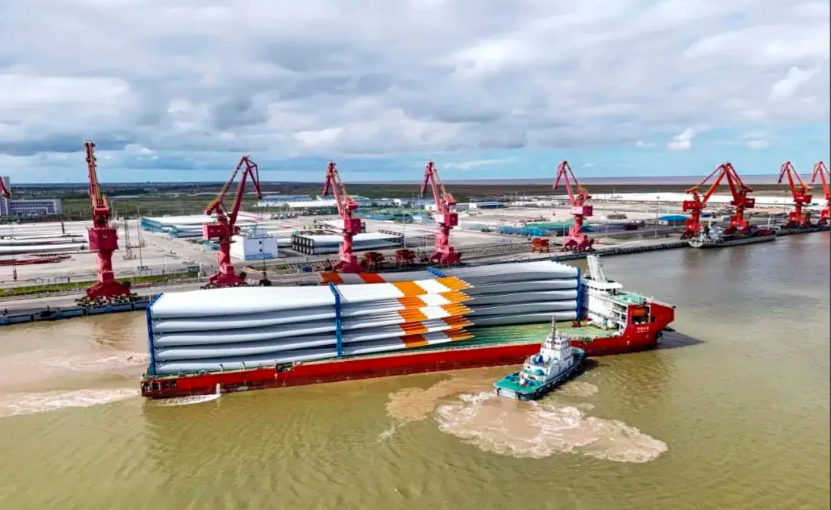
As the global energy transition enters a deep-water phase, Chinese wind power enterprises are leveraging the strategic wisdom of “encircling cities from rural areas” to launch a new wave of expansion in the international market. From offshore wind power projects in Southeast Asian islands to off-grid wind power clusters in Africa, from wind-solar hybrid power stations in Latin American countries to offshore wind power orders in Europe, China’s wind power equipment export volume exceeded 80 billion yuan in 2024, a year-on-year increase of 47%. Its share in the global new wind power installed capacity rose to 35%, demonstrating a qualitative change from “product export” to “whole industry chain going global”.
The core of the “encircling cities from rural areas” strategy lies in avoiding the barriers of mature markets in Europe and the United States and first cultivating emerging markets to establish advantages. In Southeast Asia, the 600 MW wind power project provided by Goldwind Science & Technology for Binh Thuan Province, Vietnam, adopts customized units adapted to high-temperature and high-humidity environments, with a cost 18% lower than that of European brands. Mingyang Smart Energy’s wind power park built in the Thar Desert of Pakistan has solved the problem of unstable local power grids through the “wind power + energy storage” model and has become a benchmark project of the China-Pakistan Economic Corridor. These emerging markets not only provide Chinese enterprises with opportunities for large-scale verification but also accumulate technical experience in dealing with complex geological and climatic conditions. As of 2025, Chinese wind power enterprises have completed adaptive technical reserves in 120 countries around the world, and models for special environments such as deserts, high altitudes, and typhoons account for 62%.
While consolidating the “rural” base, Chinese enterprises are opening the door to “cities” with technological breakthroughs. In May 2025, China Three Gorges Energy, in conjunction with Dongfang Electric, won the bid for the 300 MW offshore wind power project in the North Sea of Germany. Its independently developed 18 MW unit set a world record for single-unit capacity, and the cost per kilowatt-hour is 12% lower than that of local mainstream models. More symbolically, Goldwind Science & Technology expanded the scale of its European local service team to 300 people by acquiring a German wind power operation and maintenance enterprise, successfully entering the operation and maintenance market dominated by Siemens Gamesa. The effect of this “technology + localization” combination is remarkable: the share of Chinese wind power equipment in the European market has jumped from 3% in 2020 to 17% in 2025, especially in the offshore wind power field, breaking the long-term monopoly of European enterprises with breakthroughs in core technologies such as blade aerodynamic design and floating foundations.
Supporting the implementation of this strategy is the full-chain advantage of China’s wind power industry. From Luoyang LYC’s wind power bearings to Shanghai Electric’s converters, a complete industrial chain covering core components, whole machine manufacturing, and engineering construction has been formed in China, with a localization rate exceeding 95%. This makes the delivery cycle of Chinese wind power equipment 40% shorter than that of European and American enterprises. More importantly, the “integration of industry and finance” model – the 200 billion yuan green going-global fund established by the China Development Bank provides special loans with an interest rate 1.5 percentage points lower than the international market rate for overseas projects. In bidding in countries such as Brazil and Egypt, Chinese enterprises can often win with packaged solutions of “equipment + financing + operation and maintenance”.
The urgency of the global energy transition provides an era opportunity for this strategy. Data from the International Energy Agency shows that emerging markets need to add 1.2 TW of wind power installed capacity by 2030, but their local manufacturing capacity is insufficient, making Chinese enterprises’ cost-effective solutions a rigid demand. At the same time, European wind power enterprises are limited by supply chain shortages and high costs, and their market share continues to shrink. Under this supply-demand mismatch, the going-global path of China’s wind power has upgraded from simple equipment export to “standard export” – the “Wind Power Construction Specifications in Tropical Regions” compiled by PowerChina has been adopted by 7 Southeast Asian countries and become a regional general standard.
As the blades of China’s wind power rotate around the world, behind them is the inevitable logic of industrial upgrading: from following and imitating to independent innovation, from price competition to value competition, from product trade to ecological co-construction. This “encircling cities from rural areas” going-global strategy not only reshapes the global wind power industry pattern but also becomes a model for China’s high-end manufacturing industry to break through international barriers. In the wave of the new energy revolution, whoever can accurately grasp the market gradient will occupy a more active position in the global energy landscape.