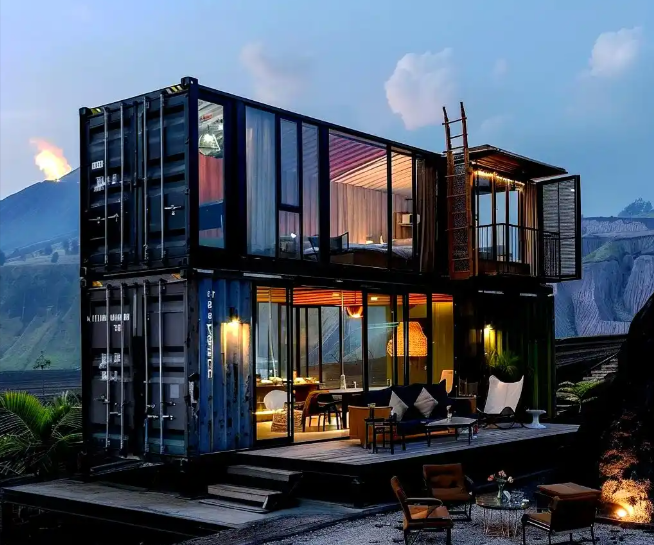
When “decluttering and letting go” becomes a life attitude and “lightweight” becomes a consumption trend, a form of housing born from industrial waste is quietly gaining popularity — container villas. With their unique industrial aesthetics, flexible renovation space, and low cost threshold, they have become a new choice for young people to escape the rat race and embrace a personalized life. These “mobile castles” transformed from retired freight containers are redefining what a “home” looks like.
I. From Industrial Waste to Living Space: The Counterattack Journey of Containers
Containers are originally a product of globalized trade. The standard-sized (commonly 20-foot, 40-foot) steel boxes are sturdy and durable, but they also become an environmental problem due to the difficulty in handling after retirement. However, designers have taken a fancy to their inherent advantages:
Robust structure: Wind and earthquake resistance far exceed ordinary residential buildings, capable of withstanding earthquakes above magnitude 8 and strong typhoons;
Modular assembly: Free combination like Lego blocks — a single container can be a studio, while multiple containers can be spliced to create a two-bedroom, one-living room structure or even a duplex with a courtyard;
Outstanding cost-effectiveness: A retired container costs only 10,000-30,000 yuan, and with renovation expenses, the total cost is often less than 1/3 of that of traditional house construction.
A Zhejiang-born post-90s designer in Beijing’s Huairou District used 3 40-foot containers to piece together a 180-square-meter home: the main container serves as the living room and kitchen, the side container is transformed into a bedroom and study, and the container added on top is turned into a starry sky terrace. “The most difficult part is heat preservation and insulation,” he shared. “We installed polyurethane insulation layers on the inner walls and sprayed reflective coatings on the outer walls. In summer, the indoor temperature is 5℃ lower than the outdoor; in winter, the temperature can be maintained at 20℃ with floor heating.”
II. A Container for Personal Expression: Infinite Possibilities in Limited Space
The charm of container villas lies in their breaking of the rigid impression of traditional residences, becoming an extension of young people’s personalities.
Industrial style enthusiasts retain the original rust of containers, matching exposed pipelines and metal furniture to create a rugged “wasteland aesthetic”;
Nature lovers cover the exterior of the containers with green walls, and use logs and cotton-linen soft furnishings inside to neutralize the coldness of steel, creating a “small wooden house in a steel forest”;
Minimalists prefer the design of “small but complete”: folding dining tables, lift beds, and hidden storage rooms allow a 15-square-meter single container to meet living needs.
The “mobile studio” of Xiao Lin, a girl from Hangzhou, is a model example: she painted the container macaron pink, installed a full-length floor-to-ceiling window on the side, with half of the interior as a clothing design workbench and the other half as a rest area. Solar panels are mounted on the roof, connected to energy storage batteries to achieve off-grid power supply. “Last summer, I drove it to travel around East China, stayed by Taihu Lake for half a month, and at the foot of Huangshan for three weeks. I start working when inspiration strikes, and enjoy the scenery when I’m tired.”
III. More Than Just “Cool”: The Underlying Life Philosophy and Practical Considerations
Young people choose container villas not only to pursue novelty but also to implicitly reflect on traditional lifestyles:
Anti-rat race living freedom: No need to bear huge mortgages — 300,000 yuan can buy a mobile “permanent property right house”, giving young people the confidence to jump out of the “work-repay loan” cycle;
Low-desire eco-friendly life: Small spaces force people to streamline their belongings, and the application of solar energy and rainwater recycling systems conforms to the concept of sustainable development;
Flexible space sovereignty: Tired of the city? You can hoist the villa onto a truck and move to the seaside or mountains, realizing the idea that “where the heart is at peace is my home”.
However, this lifestyle also faces practical challenges: the property rights of container buildings are vaguely defined in some areas, additional coordination is needed for water and electricity access, and winter heating costs are relatively high. But with the improvement of policies (such as the introduction of container homestay regulations in Hainan, Yunnan and other regions), these problems are gradually being solved.
IV. The Future Is Here: Container Communities Are Emerging
Today, container villas have developed from individual attempts to cluster development. Chengdu’s “Box Village” gathers more than 20 container households, sharing kitchens, laundry rooms and activity spaces; Shanghai’s suburban “Innovation Box Zone” has become a gathering place for entrepreneurs, where containers are transformed into studios, cafes and co-working offices, forming a vibrant micro-community.
As architect Shūhei Aoyama said: “A good living space is not about how big it is, but whether it can make people feel free.” The popularity of container villas may just confirm this point — when young people no longer equate “buying a house” with “success”, and when living returns to the essence of “comfort and freedom”, a more diverse and inclusive era of living is quietly beginning.
If you are also tired of the monotonous commercial housing, you might as well imagine: on a grassland, there is a steel box painted in your favorite color, containing your books, your cat, and your dreams, with the wheels of the box always pointing to the distance.