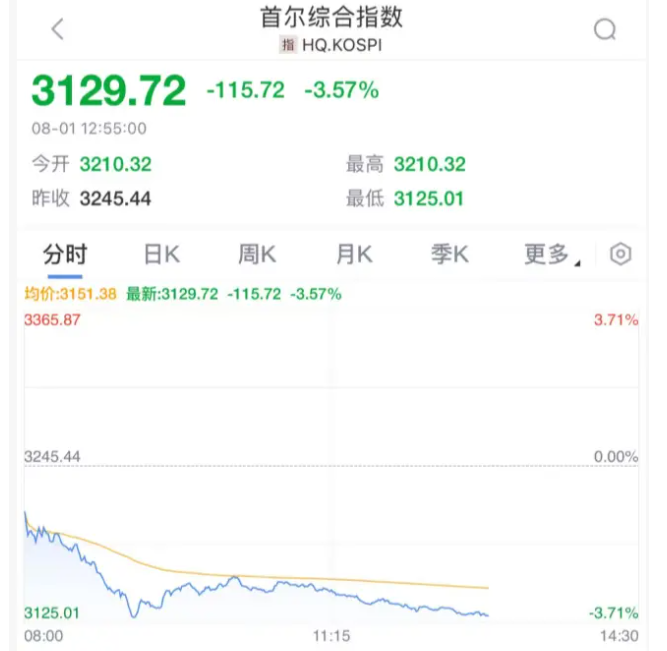
South Korean stock market plummets 4%: Tax increase policy hits investor confidence, world’s hottest market hits cold
On August 1st, the South Korean stock market experienced a significant sell-off, with the Seoul Composite Index (KOSPI) plummeting nearly 4%, marking the largest daily decline since early April and leading the decline in Asian markets. The direct trigger for this sharp decline was the sudden announcement of a tax increase plan by the South Korean government, which raised concerns among investors about the market outlook.
Tax increase policy hits market, retail investors collectively protest
The South Korean Ministry of Finance announced a proposal on Thursday to significantly increase capital gains tax and transaction tax:
The threshold for capital gains tax has been lowered from 5 billion Korean won (approximately 710000 US dollars) to 1 billion Korean won, which means more investors will be subject to taxation;
The stock trading tax has been raised from 0.15% to 0.2%;
The highest corporate income tax rate has been raised from 24% to 25%, reversing the previous government’s tax reduction policy.
This policy immediately triggered a strong backlash from retail investors, and nationwide petitions quickly spread, demanding that the government withdraw the tax increase plan. As of Friday morning, the petition has received support from over 17000 people. If the number of signatures exceeds 50000, Congress will have to discuss the issue.
The hottest stock market in the world has cooled down, and foreign confidence has been dampened
Despite the KOSPI index rising over 30% this year and performing well in major global markets, the tax increase policy has led investors to reassess risks. Kim Nam ho, General Manager of Seoul Timefolio Investment Management Company, said:
The adjustment of capital gains tax will significantly increase the number of tax paying investors, and market sentiment will significantly deteriorate
In addition, Samsung Electronics fell for two consecutive days as its financial report fell short of expectations, further dragging down the market.
Li Zaiming’s government faces challenges: economic slowdown+fiscal pressure
After taking office in June, South Korean President Lee Jae myung attempted to increase fiscal revenue through tax reform to address the slowdown in economic growth and fiscal deficit. However, this policy may weaken its support among retail and foreign investors.
Previously, the South Korean stock market performed strongly due to corporate governance reforms and foreign capital inflows, but the tax increase policy may undermine market momentum, making it even more difficult for Lee Jae myung to push KOSPI above 5000 points.
The impact of the US South Korea tariff agreement is limited, and the market is more concerned about tax policies
Although South Korea has just reached a 15% tariff agreement with the United States (lower than the expected 25%) and promised to invest $350 billion in the US, the market is more concerned about domestic tax adjustments. According to Yin Zhengren, CEO of Fibonacci Asset Management:
The sudden increase in dividends and transaction taxes by the government is unexpected negative news for the market
Future outlook: Policy adjustments may become crucial
If the government insists on raising taxes, the South Korean stock market may continue to be under pressure in the short term; But if the protests escalate, policies may be adjusted. Against the backdrop of increasing global economic uncertainty, whether South Korea can maintain its position as the “hottest stock market in Asia” still depends on how the government balances fiscal demand with market confidence.