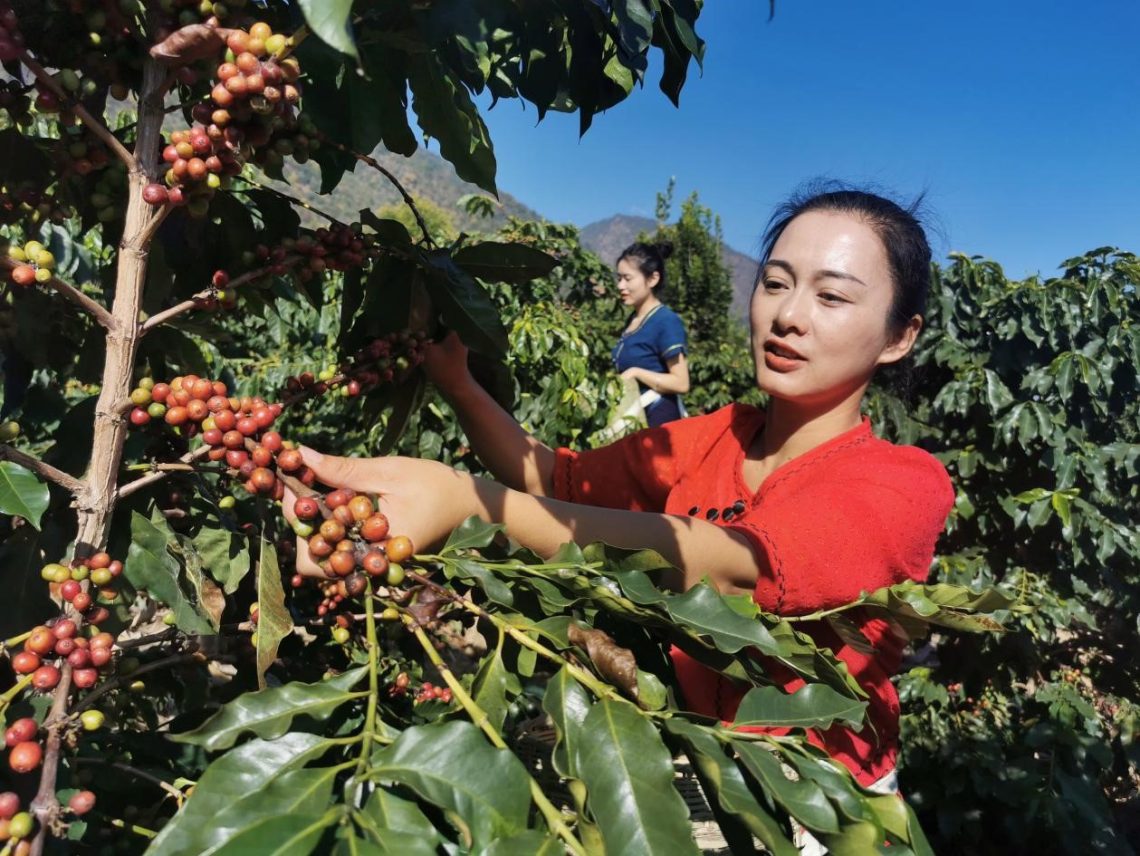
Along the Lancang River at 24°N latitude, clusters of bright red coffee cherries hang heavy on branches amidst mist-shrouded red soil. This is Yunnan, China’s core coffee-growing region, accounting for 98% of the nation’s coffee cultivation area and production. From its first large-scale introduction in 1952 to today’s specialty beans fetching over 10,000 yuan per kilogram at auctions and exported to 29 countries and regions, Yunnan coffee has undergone a remarkable transformation over seven decades—evolving from a mere “raw material supplier” to a “national ambassador.” This journey is driven by the synergy of three forces: natural endowment, technological empowerment, and industrial innovation.
Natural Heritage: Golden Regions Cultivate Distinctive Flavors
Yunnan coffee’s rise stems from irreplaceable natural endowments. Sharing the world’s golden coffee belt with Colombia, its low-latitude, high-altitude geography (900–1,800 meters) combined with a subtropical monsoon climate featuring significant day-night temperature variations allows Arabica beans to accumulate abundant flavor compounds. This results in a distinctive profile characterized by “richness without bitterness, aroma without harshness, and subtle fruity notes.” Volcanic soils along the Lancang and Nujiang rivers, rich in minerals, impart a pure foundation to the beans. This advantage propelled Baoshan Small Grain Coffee to win the Gold Medal at the 1993 Brussels Eureka Fair and secure inclusion in the inaugural EU-recognized list of Chinese Geographical Indication Protected Products in 2020.
By the end of 2024, Yunnan’s coffee cultivation area reached 1.267 million mu (approximately 84,467 hectares), with a production volume of 146,000 tons and an agricultural output value nearing 5 billion yuan. Three core production areas have emerged: Pu’er, Baoshan, and Lincang. Baoshan City leads the province with a comprehensive output value of 9 billion yuan, ranking first in deep processing rate, specialty coffee rate, and number of provincial-level leading enterprises, solidifying its role as the core pillar of “China’s Coffee Capital.”
Technological Breakthrough: From “Caturra Dependency” to “Yunnan Coffee’s Rise”
For years, limited variety and low premium coffee rates have constrained Yunnan’s coffee development. To overcome this challenge, the Yunnan Academy of Agricultural Sciences’ Tropical Crops Research Institute spent 73 years developing 22 new coffee varieties. The “Yunka Series” emerged as the key to quality breakthroughs. At the inaugural 2025 Yunnan Treasure Green Coffee Bean Competition, six samples from the “Yunka No. 1” and ” Yunka No. 2″ secured six spots on the award list. A sun-dried Yunka No. 1 sample cultivated by Baoshan farmers fetched a premium price of 2,100 yuan per kilogram with a cupping score of 88.83. Yunka No. 2 further distinguished itself by achieving 86.75 points, placing it among the world’s specialty coffees.
Technological empowerment extends beyond breeding. Over 60% of Yunnan’s coffee farms have adopted water-fertilizer integration and green pest control technologies. Average yields in standard demonstration plots reached 139.06 kilograms per mu, 2.38 times the global average. In processing, techniques like cold-brew freeze-drying and microbial fermentation are widely adopted. The province’s deep processing rate surged from 20% in 2021 to 80% in 2024, yielding diversified products including roasted beans, freeze-dried powder, and coffee cherry tea—truly realizing the value of every part of the coffee bean.
Industrial Upgrade: From “Single-Crop Cultivation” to “Three-Industry Integration”
Today, Yunnan’s coffee industry is moving beyond the low-end model of “selling only green beans,” establishing a full-chain development pattern integrating “cultivation + processing + cultural tourism.” At the Dakahe Coffee Estate in Pu’er, visitors can experience the entire process from picking and fermentation to roasting. In 2024, the estate welcomed over 500 visitors per day. Xinzhai Village in Baoshan City has established itself as “China’s First Coffee Village,” developing five themed estates that welcomed 200,000 visitors in 2024, boosting villagers’ per capita disposable income to over 30,000 yuan. This “coffee-tourism integration” model enables Yunnan’s coffee estates to host over one million visitors annually, with the combined output value of the three industries exceeding 9 billion yuan.
Branding and internationalization advance in tandem. Local brands like Zhongka and Four Cats have risen through the “e-commerce + production base” model, while innovative brands such as “Four Leaf Coffee” and “Huatian Cui” blend Yunnan coffee with local elements like Pu’er tea and roses to penetrate first-tier city markets. Internationally, Yunnan exported 32,500 metric tons of coffee in 2024—a 358% year-on-year surge—reaching 29 countries and regions including the Netherlands, Germany, and the United States. The inaugural Yunnan Excellence Cup pilot competition marked Yunnan coffee’s first entry into the prestigious COE (Coffee of Excellence) evaluation system, signaling China’s formal entry into the global specialty coffee arena.
Policy Support: “Six Coffee Measures” Illuminate Development Path
Yunnan coffee’s rapid growth relies on targeted policy support. Provincial-level initiatives like the “Six Coffee Measures” designated 105,000 acres as premium coffee cultivation zones, providing comprehensive backing for variety renewal, processing upgrades, and brand development. The Yunnan Plateau Specialty Agriculture Supply Chain (Coffee) Service Platform, established by the Provincial Agricultural Development (Agricultural Reclamation) Group, provides comprehensive logistics and financial support for industry growth. Guided by these policies, Yunnan’s specialty coffee rate surged from under 8% in 2021 to 31.6% in 2024, with green bean prices averaging 14.1% higher than international Arabica coffee—finally breaking the “high quality, low price” curse. From the first coffee seed planted along the Lancang River to becoming a “Chinese flavor” in global markets, Yunnan coffee has demonstrated its confidence in the saying “China’s coffee scene looks to Yunnan” through over seventy years of perseverance and innovation. As Pan Wenbin, Chief Economist of Yunnan’s Department of Agriculture and Rural Affairs, remarked: “The rise of Yunnan coffee represents not only an industrial triumph but also a vivid demonstration of how Chinese specialty agricultural products are making their mark on the world stage.” In the years ahead, the aroma of coffee from this red soil will undoubtedly drift farther and linger longer.